



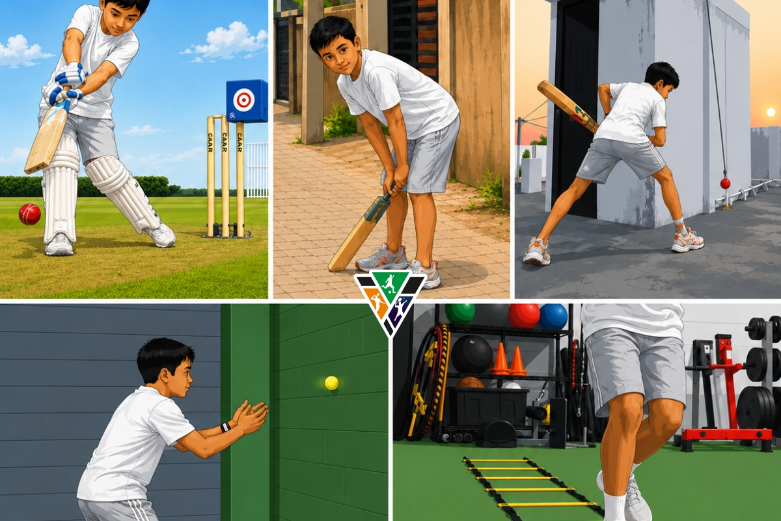
For young cricketers, training doesn’t have to stop when they leave the field. Many of the skills that define great players — timing, balance, hand-eye coordination, and concentration — can be developed right at home with simple drills and regular practice.
In fact, several legendary cricketers built their foundational skills through backyard or indoor practice sessions long before they stepped onto professional grounds. At Vidyanchal Sports Academy, young players are often encouraged to supplement their academy sessions with safe and structured home drills to strengthen their technique.
Practicing cricket at home not only improves physical skills but also builds discipline and familiarity with the game. Here are five effective ways to practice cricket at home, along with examples from two great cricketers whose training habits shaped their careers.
Shadow Batting to Perfect Technique
One of the simplest yet most powerful cricket drills is shadow batting. This exercise involves practicing batting movements without a ball.
The goal is to build muscle memory by repeating correct batting technique — stance, backlift, foot movement, and follow-through.
A typical shadow batting routine includes:
- Standing in batting stance
- Practicing forward defense and drives
- Practicing back-foot shots
- Repeating the swing slowly with focus on balance
Young players can perform this drill in a small open space at home.
This method was famously used by Sachin Tendulkar during his early training years. His childhood coach often made him rehearse batting movements repeatedly without a ball to perfect his balance and shot preparation.
Shadow batting helps players develop rhythm and posture — two elements that are difficult to correct once poor habits form.
Wall Throw and Catch Drill
Fielding and reflexes are crucial parts of cricket, yet they are often overlooked during individual practice. A wall throw drill is an excellent way to improve hand-eye coordination.
How to do it:
- Stand a few feet away from a wall.
- Throw a tennis ball against the wall.
- Catch it on the rebound with one or both hands.
Variations can include:
- One-hand catches
- Quick reaction catches
- Throwing at different angles
This drill sharpens reaction time and catching ability.
Legendary wicketkeeper-batsman Adam Gilchrist often credited wall rebound drills during his early training for developing fast reflexes and strong glove work.
Practicing this regularly helps young cricketers become more confident fielders.
Batting with a Hanging Ball
Another excellent drill for home practice involves a ball suspended from a string. This setup allows players to practice timing without needing a bowler.
How it works:
- Hang a tennis ball from a ceiling or tree branch.
- Adjust the height so it aligns with batting position.
- Practice controlled strokes by hitting the ball and letting it swing back.
Benefits include:
- Improving hand-eye coordination
- Learning to watch the ball closely
- Practicing straight drives and defensive shots
Because the ball returns after each shot, players can repeat movements continuously.
This drill is widely used in grassroots cricket coaching because it helps young players develop control rather than power.
Footwork Ladder Drills
Batting and bowling in cricket require excellent footwork. Quick movement helps players adjust to ball length and maintain balance while playing shots.
An agility ladder — or even chalk lines drawn on the ground — can help practice foot movement drills.
Simple drills include:
- Forward and backward steps
- Side-to-side movement
- Quick pivot steps
These exercises improve:
- Balance
- Speed
- Coordination
Footwork training also reduces injury risk by strengthening lower-body stability.
At Vidyanchal Sports Academy, similar agility drills are used during warm-ups to help players move efficiently across the pitch.
Target Bowling Practice
Young bowlers can improve accuracy by practicing target bowling drills at home.
To set up the drill:
- Place small targets such as cones, bottles, or chalk circles on the ground.
- Aim to bowl consistently at the same spot.
Bowlers can practice:
- Line and length
- Consistency of delivery
- Wrist position
Using tennis balls or soft cricket balls is ideal for home practice.
Repeated target practice teaches bowlers control — one of the most important aspects of effective bowling.
Even professional bowlers spend hours refining their accuracy through similar drills.
Why Home Practice Matters
Home practice complements academy training by reinforcing fundamentals. While structured coaching provides expert guidance, individual practice helps players internalize techniques.
Benefits of home practice include:
- Developing discipline and routine
- Building confidence with equipment
- Improving concentration
- Strengthening muscle memory
Even 15–20 minutes of focused practice at home can significantly improve a young player’s performance over time.
At Vidyanchal Sports Academy, students are often encouraged to continue practicing simple drills at home to support their on-field training.
Safety Tips for Practicing Cricket at Home
While home practice is beneficial, safety should always come first.
Parents should ensure that:
- Soft balls are used in confined spaces
- Windows and fragile objects are protected
- Adequate space is available for swings and throws
- Children warm up before practicing
Supervision is also important for younger players.
With the right precautions, home practice can be both productive and enjoyable.
Building Consistency Through Routine
The most successful athletes share one common trait — consistency. Small, regular practice sessions often lead to better results than occasional long sessions.
Young players can create a simple weekly routine such as:
- 10 minutes of shadow batting
- 10 minutes of catching drills
- 10 minutes of footwork exercises
Over time, these habits build strong cricket fundamentals.
Final Thoughts
Cricket training doesn’t always require a full field or professional nets. With creativity and dedication, young players can develop many essential skills right at home.
Shadow batting, wall catches, hanging ball practice, footwork drills, and target bowling are simple yet highly effective ways to improve cricket technique. These methods have been used by great cricketers like Sachin Tendulkar and Adam Gilchrist to sharpen their skills long before international success.
At Vidyanchal Sports Academy, structured coaching combined with consistent home practice helps young athletes build confidence, discipline, and technical strength.
Because in cricket — as in any sport — improvement comes from repetition, patience, and a genuine love for the game.