



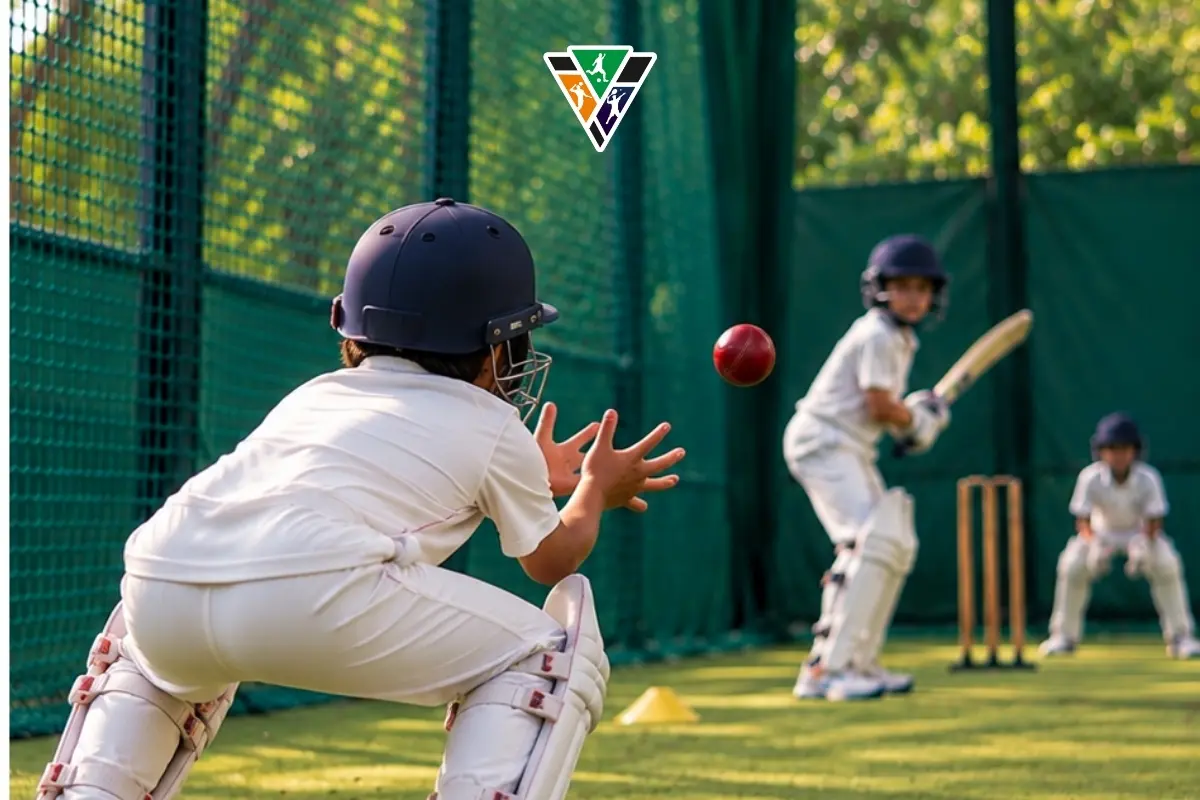
Cricket fielding drills for kids are an essential part of developing a complete young cricketer. Fielding is sometimes treated as something that happens between batting and bowling practice, but it develops several fundamental athletic abilities at once — including reaction speed, agility, coordination, balance, acceleration and throwing accuracy.
At Vidyanchal Sports Academy, fielding is treated as a core cricket skill. Children learn how to read the ball, move efficiently, collect it cleanly and throw accurately while gradually building the confidence required to perform under match conditions.
Research supports the athletic demands of fielding. Studies of cricket players have found that acceleration and the first few steps are particularly important when moving quickly towards a ball. Catching also involves the coordination of visual attention, reaction time and hand movement. The important point for young players is that these abilities can be developed progressively through simple, age-appropriate drills.
Why Fielding Matters for Young Cricketers
A single fielding action can change a cricket match.
A quick stop can save four runs. A clean pickup can prevent an extra run. A sharp throw can create a run-out opportunity, while a difficult catch can dismiss a key batter.
Good fielding therefore requires much more than having “good hands.”
A young fielder needs to:
- Watch the ball
- Judge its direction
- Accelerate towards it
- Maintain balance
- Collect it correctly
- Throw accurately
These movements make fielding an excellent way to develop general athletic ability alongside cricket technique.
Reaction Ball Roll
This is a simple drill for developing reaction speed.
The coach rolls a ball approximately 5–7 metres away from the child, slightly to either side.
The child must:
- Start in a ready position.
- React to the direction of the ball.
- Move towards it.
- Get low behind the ball.
- Collect it with both hands.
For younger children, a tennis ball or softer training ball can be used.
The objective is not maximum speed. It is seeing, reacting and moving correctly.
Research on catching and reaction performance in children shows that successful catching involves both reaction time and coordinated movement, making this combination particularly useful in youth training.
Cone Reaction Drill
Place four cones around the child — approximately 3–5 metres away.
The coach calls:
- Left
- Right
- Forward
- Back
The child moves towards the appropriate cone and returns.
Once comfortable, introduce a rolled ball after the directional call.
This develops:
- First-step speed
- Change of direction
- Balance
- Spatial awareness
- Reaction time
For children, the drill can also be turned into a simple competition or reaction game.
Build Better Fielders Through Better Coaching
Pick-Up and Throw Drill
This is one of the most important basic fielding movements.
Roll the ball approximately 8–10 metres away.
The child should:
- Move towards the ball
- Lower their body
- Get behind the ball
- Pick it up securely
- Transfer it into the throwing hand
- Throw towards the stumps
Start with a large target and gradually make it smaller.
The sequence should become natural:
Move → collect → transfer → throw.
This drill combines agility, coordination and throwing accuracy in one movement.
Quick Hands Catching Drill
Catching should begin with simple, controlled throws.
The coach can throw gently towards:
- Chest height
- Waist height
- Left side
- Right side
Children should learn to watch the ball closely, move their hands towards it and absorb the catch rather than snatching at it.
Research into children’s catching ability shows that catching develops significantly with age and practice. This is why expectations should remain age-appropriate.
A young child dropping a difficult catch is not necessarily demonstrating poor ability. They may simply still be developing the required coordination.
Tennis Ball Wall Catch
A wall can become an excellent fielding practice partner.
The child stands approximately 2–4 metres from a wall and throws a tennis ball against it before attempting to catch the rebound.
Progressions can include:
Beginner: Two-handed catches.
Intermediate: Alternating hands.
Advanced: Throw, clap once, catch.
Reaction: Move sideways before catching.
This allows children to complete many repetitions without needing another player.
Explore the Grounds Where Young Cricketers Train
Discover the cricket nets, grounds and training spaces at Vidyanchal Sports Academy.
Mirror Movement Game
Fielding isn’t always about chasing a ball. Players also need to stay light on their feet and react to changing situations.
Two children face each other.
One becomes the leader and moves:
- Sideways
- Forward
- Backward
- Diagonally
The second player mirrors those movements.
After 20–30 seconds, they switch roles.
This develops agility, body awareness and reaction to movement while keeping training playful.
One-Bounce Fielding Challenge
For slightly older beginners, introduce a ball that bounces once before reaching the fielder.
The player has to judge:
- Speed
- Bounce
- Direction
- Distance
The coach can gradually change the angle of the delivery.
This teaches an important cricketing skill: anticipating where the ball will be, rather than simply reacting to where it is.
Agility Is More Than Speed
The fastest runner isn’t automatically the best fielder.
Fielding agility involves:
- Acceleration
- Deceleration
- Direction changes
- Balance
- Ball collection
- Throwing
Research into cricket acceleration has highlighted the importance of the first steps when players move towards a ball.
For young athletes, however, movement quality should come before maximum speed.
Turn Practice Into Match Experience
How Fielding Builds Confidence
Fielding creates frequent opportunities for visible improvement.
A child who initially avoids a difficult ball may eventually make:
- A clean stop
- A confident catch
- A faster pickup
- An accurate throw
These small achievements build confidence.
Children learn that improvement isn’t only measured through runs scored or wickets taken. Becoming a better fielder is also a meaningful part of becoming a better cricketer.
Safety Comes Before Speed
Fielding drills should always match the child’s age and ability.
Coaches should ensure:
- Proper warm-ups
- Safe playing surfaces
- Appropriate balls
- Adequate space
- Controlled throwing distances
Younger beginners can start with softer balls before progressing to harder cricket balls.
Children should also learn proper ground-fielding technique rather than being encouraged to dive unnecessarily.
Give Your Child More Time on the Field
Book a VSA turf or training facility for extra cricket practice, fielding drills and team sessions.
Final Thoughts
The best cricket fielding drills for kids don’t need complicated equipment. A few cones, a tennis ball, a wall and a set of stumps can create valuable opportunities to develop reflexes, agility, coordination, balance and confidence.
For young players, the objective isn’t simply to become faster.
It is to learn how to see the ball, react quickly, move efficiently and execute the skill with confidence.
At Vidyanchal Sports Academy, fielding is part of developing the complete cricketer — because when the ball comes your way, every second matters.
FAQs
1. What are the best fielding drills for beginners?
Reaction-ball rolls, basic catches, cone movements and pickup-and-throw drills.
2. How often should kids practice fielding?
Short 10–20 minute sessions can be effective when practiced consistently.
3. Does fielding improve overall athletic ability?
Yes. It develops agility, acceleration, coordination, balance and reaction skills.
4. Should young children use a hard cricket ball?
Beginners can start with softer training balls under appropriate supervision.
5. Why is fielding important in cricket?
It improves match performance while developing confidence and overall athletic ability.
Sources
- Journal of Sports Science and Medicine — Acceleration Kinematics in Cricketers
https://pmc.ncbi.nlm.nih.gov/articles/PMC3918548/ - PubMed — Research on catching, reaction time and age
https://pubmed.ncbi.nlm.nih.gov/12900696/ - Perceptual and Motor Skills — Research on children’s catching performance
https://journals.sagepub.com/doi/10.2466/pms.1992.75.1.211