



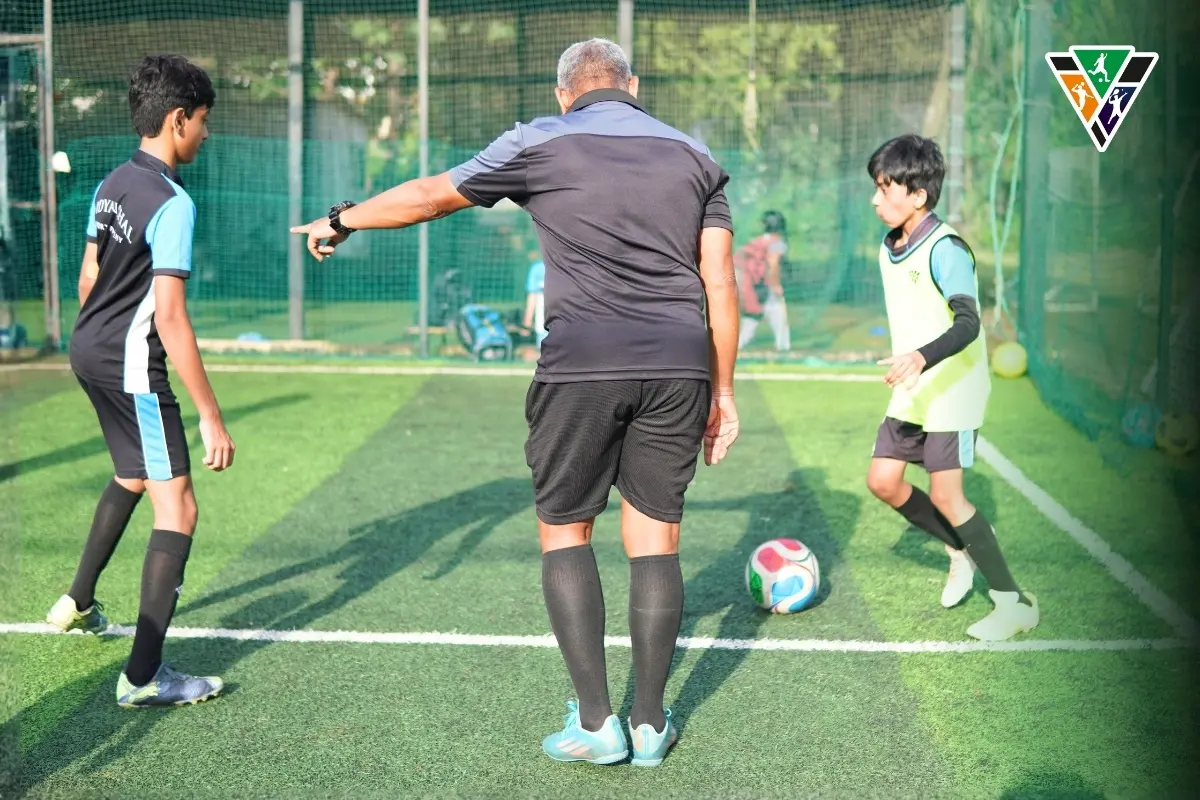
How to know if your child is ready for more serious sports training is an important question for parents whose children have started showing a genuine interest in football, cricket, basketball, skating, Mallakhamb, or another sport. Enjoying practice is one thing; increasing training demands is another.
At Vidyanchal Sports Academy, progression is not based on age alone. A child may be ready for more structured training at 9, while another may need more time at 11. Physical development, emotional maturity, consistency, recovery, and genuine interest all matter when deciding whether a child is ready to move from recreational participation towards more serious training.
Serious training should not mean treating a child like a professional athlete. For young players, it means greater structure, more deliberate skill development, increased consistency, and gradually higher sporting demands.
What Does “Serious Sports Training” Actually Mean?
The phrase can sound intimidating, but serious training for children does not necessarily mean long hours, intense conditioning, or constant competition.
It can simply mean moving from:
“I play because it’s fun”
to:
“I want to improve at this sport.”
A child entering this stage may begin to:
- Attend training consistently
- Practice specific skills
- Understand coaching feedback
- Participate in matches
- Set small goals
- Take greater responsibility for equipment and preparation
The emphasis should remain on development rather than results.
Interest Comes Before Intensity
The first question parents should ask is simple:
Does the child actually want to train more?
A child who regularly asks to:
- Play football after school
- Practice batting at home
- Shoot basketballs repeatedly
- Improve skating technique
- Learn another Mallakhamb movement
may be demonstrating genuine intrinsic motivation.
This is different from a child who participates only because parents expect them to.
Sports psychology research consistently emphasizes the importance of autonomous motivation—the feeling that participation is personally chosen rather than imposed.
At Vidyanchal Sports Academy, coaches can help parents distinguish between temporary enthusiasm and sustained interest by observing how a child responds to regular training.
Consistency Is a Bigger Signal Than Talent
A child does not need to be the best player in the group before progressing.
In fact, one of the strongest indicators of readiness is consistency.
Look for whether your child:
- Attends sessions regularly
- Tries to improve
- Listens to coaches
- Practices between sessions
- Recovers from mistakes
- Remains interested after difficult sessions
Talent may make certain skills easier initially, but consistent effort is far more important for long-term development.
Ready to Take the Next Step?
Physical Readiness Matters
Children develop at different rates, so physical readiness should not be judged purely by age.
A coach may look at:
- Coordination
- Balance
- Movement quality
- Basic strength
- Agility
- Endurance
- Ability to recover
A child does not need elite-level fitness before beginning more structured training.
Instead, they should be capable of handling the demands of their current program without persistent fatigue or recurring injuries.
The progression should be gradual.
Can Your Child Follow Instructions?
More serious training requires greater attention.
For example, a football coach may ask a player to:
- Change position
- Press at a particular moment
- Make a recovery run
A cricket coach may ask a young player to:
- Change bowling length
- Adjust their batting stance
- Practice a specific fielding technique
A basketball player may need to:
- Remember a passing pattern
- Rotate defensively
- Recognize space
The ability to listen, understand, and apply feedback is a strong sign that a child is ready for greater technical complexity.
Is Your Child Comfortable Making Mistakes?
This is one of the most overlooked indicators.
Serious training inevitably involves failure.
A batter gets out.
A footballer misses a pass.
A basketball player misses a shot.
A skater falls.
A Mallakhamb student struggles with a movement.
The important question is not whether mistakes happen. It is how the child responds to them.
A child who can make a mistake, receive feedback, and try again is developing an important quality: resilience.
Recovery Becomes More Important as Training Increases
As training becomes more demanding, recovery becomes part of the program.
Parents should monitor:
- Sleep
- Appetite
- Energy
- Mood
- Muscle soreness
- General enthusiasm
Persistent fatigue is not a sign that a child needs to “push harder.”
It can be a sign that training volume needs to be adjusted.
The American Academy of Pediatrics recommends that young athletes have adequate rest and avoid excessive training loads, particularly when participating in organized sport year-round.
At Vidyanchal Sports Academy, progression should always be age-appropriate and balanced with recovery.
School and Sport Should Still Coexist
A child ready for serious sports training should be capable of maintaining a reasonable balance between:
- School
- Training
- Homework
- Sleep
- Family
- Free play
If training consistently causes missed schoolwork, inadequate sleep, or constant stress, the schedule may be too demanding.
Serious training should teach children better time management—not eliminate everything else from their lives.
Match Interest Is Another Important Indicator
Some children love practice but have no interest in competition.
Others naturally become curious about:
- Matches
- Tournaments
- Team selection
- Performance
- Improving their statistics
Neither is wrong.
However, a growing interest in competition can indicate that a child is ready to experience a more structured pathway.
At Vidyanchal Sports Academy, children can gradually move from fundamental training towards match-based experiences as their skills and confidence develop.
Take Training Beyond the Regular Session
Book a VSA turf or facility for extra practice, team sessions, and supervised game time.
Should Children Specialize in One Sport?
Not necessarily.
For younger children, multi-sport participation can provide valuable movement experiences.
Football can develop:
- Endurance
- Agility
Cricket can develop:
- Hand-eye coordination
- Timing
Basketball can develop:
- Reaction speed
- Spatial awareness
Skating can develop:
- Balance
- Lower-body control
Mallakhamb can develop:
- Strength
- Flexibility
- Body awareness
A child can become more serious about one sport later while still benefiting from other activities.
Signs Your Child May Not Be Ready Yet
There is nothing wrong with waiting.
Parents may want to slow progression if a child:
- Frequently refuses training
- Shows persistent anxiety around competition
- Has recurring injuries
- Is constantly exhausted
- Has lost interest in the sport
- Feels pressured to perform
The solution isn’t necessarily quitting.
Sometimes the child simply needs:
- Less training
- More free play
- A different sport
- A different coaching environment
- More recovery time
Watch Training Become Competition
What Parents Can Do
Parents have an important role, but they do not need to become the coach.
Instead:
- Ask what the child enjoys
- Encourage regular attendance
- Provide adequate food and sleep
- Listen to concerns
- Avoid comparing them with teammates
- Let coaches handle technical development
One of the best questions to ask after practice isn’t:
“Did you win?”
Try:
“What did you learn today?”
That keeps the focus on development.
The Coach’s Assessment Matters
Parents may see enthusiasm at home, but coaches see the child repeatedly in a sporting environment.
A coach can assess:
- Technical ability
- Movement quality
- Training habits
- Response to instruction
- Physical readiness
- Match behaviour
This makes professional coaching feedback extremely valuable before increasing training frequency or intensity.
Final Thoughts
Knowing how to know if your child is ready for more serious sports training isn’t about identifying the youngest possible age to increase training.
It is about recognizing readiness.
Look for:
- Genuine interest
- Consistency
- Physical readiness
- Coachability
- Emotional resilience
- Healthy recovery
- Ability to balance school and sport
If these qualities are developing, your child may be ready for the next stage.
At Vidyanchal Sports Academy, progression should be about helping children become better athletes without taking away what made them love sport in the first place.
Serious training should mean more purpose, not more pressure.
Because the goal isn’t to make a child train like a professional as early as possible. It is to give them the right environment to become one of the best versions of themselves—whatever level of sport they eventually choose.
FAQs
1. What is the best age to start serious sports training?
There is no universal age. Readiness depends on development, interest, and the sport.
2. Does my child need to be naturally talented?
No. Consistency, coachability, and genuine interest are often more important.
3. How do I know if training is becoming too much?
Watch for persistent fatigue, injuries, poor sleep, mood changes, or loss of interest.
4. Should children specialize in one sport early?
Not necessarily. Multi-sport participation can support broader athletic development.
5. What should parents prioritize before increasing training?
Look for healthy recovery, consistent interest, good coaching, and a manageable school-sports balance.