



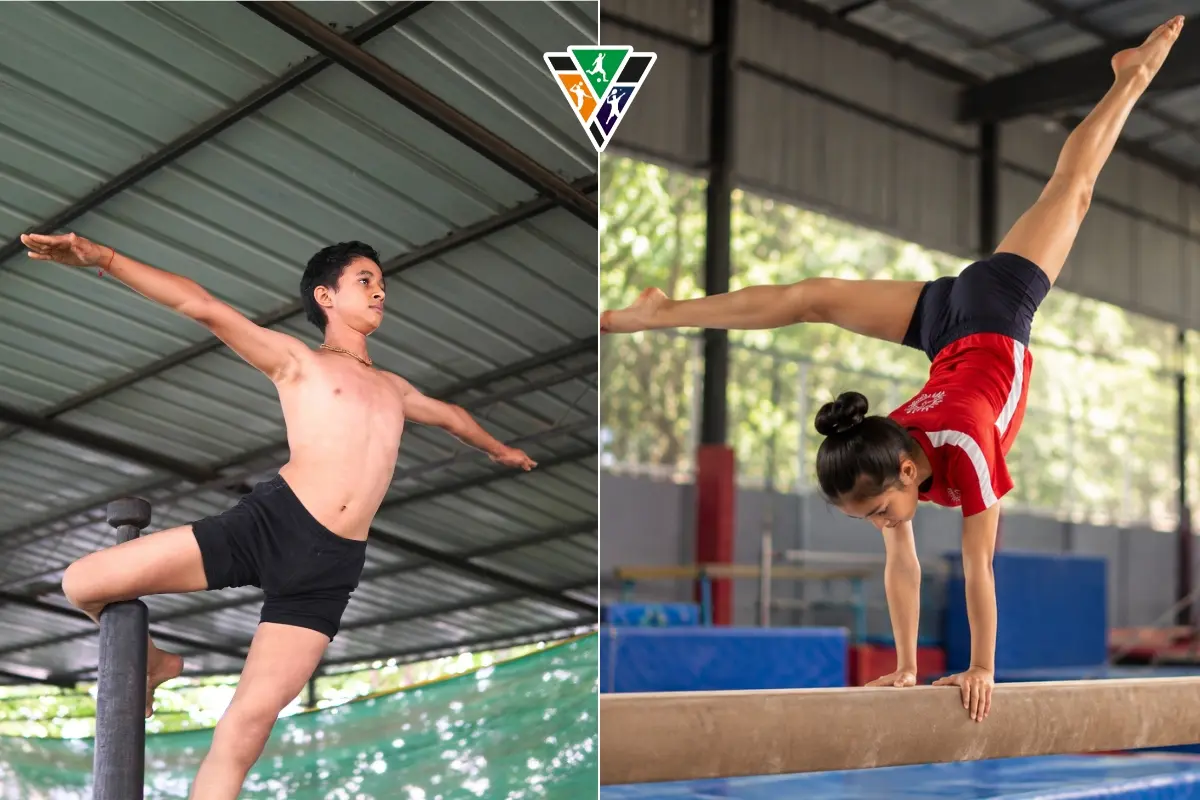
Mallakhamb vs gymnastics for kids is an interesting comparison for parents looking for a sport that develops strength, flexibility, balance, and body control. Both disciplines demand concentration, coordination, mobility, and physical discipline, but they train these qualities in distinctly different ways.
At Vidyanchal Sports Academy, Mallakhamb gives children an opportunity to develop these abilities through an Indian sporting tradition built around poles and ropes. Gymnastics, meanwhile, uses apparatus such as floor areas, bars, beams, vaults, and rings to develop highly controlled movement.
Neither sport needs to be considered universally “better.” The more useful question is: what kind of physical abilities does each one develop, and which environment suits your child?
Mallakhamb and Gymnastics: Similar Foundations, Different Movement
At first glance, Mallakhamb and gymnastics can look remarkably similar.
Both involve:
- Strength
- Flexibility
- Balance
- Coordination
- Body awareness
- Controlled movement
- Spatial awareness
- Mental concentration
The difference lies largely in how the child interacts with the apparatus.
Gymnastics generally teaches children to control their bodies across a variety of apparatus and surfaces. Mallakhamb places the body around a vertical pole, hanging pole, or rope, requiring the athlete to grip, climb, rotate, invert, balance, and transition around a relatively narrow apparatus.
That changes the physical challenge considerably.
What Is Mallakhamb?
Mallakhamb is a traditional Indian sport combining elements of strength, gymnastics, yoga, and wrestling.
The word comes from malla, meaning wrestler, and khamb, meaning pole. Historical references to Mallakhamb can be traced to the 12th-century text Manasollasa, while the modern form of the discipline is associated with Balambhatta Dada Deodhar, a physical instructor connected with the Peshwa period in the 19th century.
Modern Mallakhamb includes three major forms:
- Pole Mallakhamb
- Rope Mallakhamb
- Hanging Mallakhamb
The sport was later formalized competitively in India, with Mallakhamb appearing in the National Gymnastics Championships in 1958 and a National Mallakhamb Championship following in 1962.
This history is particularly relevant for children in Pune and Maharashtra, where the sport has deep cultural roots.
What Does Gymnastics Develop?
Gymnastics is a broad discipline rather than a single movement style.
Depending on the discipline, children may work with:
- Floor exercises
- Balance beam
- Uneven bars
- Parallel bars
- Vault
- Rings
- Pommel horse
This variety develops a broad range of physical abilities.
Gymnastics particularly emphasizes:
Flexibility: Children learn controlled ranges of movement.
Balance: Apparatus such as the beam require precise positioning.
Coordination: Movements often require several body segments to work simultaneously.
Explosive strength: Vaults, jumps, and tumbling require powerful take-offs.
Spatial awareness: Children learn to understand where their body is while rotating or moving through the air.
Gymnastics therefore provides an excellent foundation for children who enjoy structured, highly technical movement.
What Makes Mallakhamb Different?
Mallakhamb introduces a distinctive challenge: the apparatus itself becomes part of the body-control problem.
On the pole, children learn to use combinations of:
- Grip
- Legs
- Core
- Shoulders
- Hip positioning
- Friction
- Body weight
The wooden pole provides a vertical axis around which movements occur.
On rope Mallakhamb, the challenge changes again because the rope moves and requires continuous adjustments to balance and grip. Mallakhamb India describes pole, hanging, and rope forms as distinct apparatus disciplines involving mounts, holds, acrobatic elements, catches, and dismounts.
This makes Mallakhamb particularly interesting for developing whole-body control.
Discover Mallakhamb at Vidyanchal Sports Academy
Strength: Which One Develops It Better?
The answer depends on the type of strength being discussed.
Gymnastics develops considerable relative strength — the ability to control one’s body relative to its weight. Children repeatedly push, pull, support, hold, jump, and land.
Mallakhamb also develops relative strength, but grip and pulling strength become especially important because the child must maintain contact with the apparatus while moving vertically or around it.
Mallakhamb therefore places distinctive demands on:
- Grip strength
- Core strength
- Shoulder stability
- Hip and leg control
- Isometric strength
Gymnastics offers a wider range of strength demands across different apparatus.
So rather than saying one develops “more strength,” it is more accurate to say that the strength requirements are different.
Balance: Stable Surface vs Moving Body
Balance is another area where the two sports differ significantly.
Gymnastics may require a child to maintain a precise position on a narrow beam or land accurately after a tumbling sequence.
Mallakhamb asks the child to maintain balance while:
- Climbing
- Rotating
- Hanging
- Inverting
- Transitioning between positions
The child is constantly adjusting the relationship between their centre of mass and the apparatus.
This makes Mallakhamb particularly demanding from a dynamic balance perspective.
Body Control and Proprioception
One of the most important concepts in both sports is proprioception.
Proprioception is the body’s ability to sense the position and movement of its limbs without constantly looking at them.
A child develops this through repeated movement.
In gymnastics, this might happen through:
- Tumbling
- Landings
- Rotations
- Beam work
In Mallakhamb, it happens through:
- Pole climbs
- Inverted positions
- Rotations around the apparatus
- Controlled holds
- Rope movements
This is why both sports can become excellent foundations for children who later participate in other athletic activities.
Flexibility Is Not Just About Stretching
Both disciplines require flexibility, but flexibility alone isn’t enough.
A young athlete needs active flexibility — the ability to control a limb through a large range of movement.
For example, being able to lift a leg high is different from being able to hold it there while maintaining balance.
Gymnastics develops this through highly technical positions and movements.
Mallakhamb develops flexibility while simultaneously demanding grip, strength, and body control.
This combination is one of its defining characteristics.
Build Strength That Transfers Beyond One Sport
Safety: What Parents Should Know
Neither sport should be approached as something children simply experiment with independently.
Both require:
- Qualified supervision
- Age-appropriate progression
- Proper warm-ups
- Appropriate equipment
- Safe training surfaces
- Controlled progression
Mallakhamb involves elevated positions and should therefore be taught under experienced supervision.
Gymnastics similarly involves falls, rotations, and landings that require proper instruction.
Parents should never judge safety purely by watching an advanced performance. What matters is how beginners are introduced to the discipline.
At Vidyanchal Sports Academy, Mallakhamb training is conducted using dedicated poles and ropes in a cushioned, supervised environment.
Which Sport Is Better for Your Child?
Instead of choosing based on which sport looks more impressive, consider what your child naturally enjoys.
Mallakhamb may suit children who enjoy:
- Climbing
- Hanging and gripping
- Bodyweight challenges
- Traditional Indian sports
- Vertical movement
- Strength-based activities
Gymnastics may suit children who enjoy:
- Tumbling
- Jumps
- Apparatus variety
- Precise sequences
- Floor routines
- Acrobatics
Some children may enjoy both.
And that’s perfectly fine.
Mallakhamb Has a Unique Indian Sporting Heritage
One of the strongest reasons to introduce children to Mallakhamb is that it connects physical development with Indian sporting history.
The sport evolved from physical training traditions associated with wrestlers and later became a formal competitive discipline. Government sources describe Mallakhamb as a traditional Indian sport combining elements of gymnastics, yoga, and strength training.
Its modern competitive history also demonstrates that this is not simply a cultural performance. It is a demanding sport requiring serious physical preparation.
Maharashtra has remained an important centre of Mallakhamb. At the 2022 National Games, Maharashtra’s Mallakhamb athletes won three of the five gold medals available in the discipline, demonstrating the state’s continued strength in the sport.
For children growing up in Pune, this creates an opportunity to engage with a sporting tradition that is geographically and culturally close to home.
Why Body Control Matters Across Sports
The real advantage of either Mallakhamb or gymnastics may be what happens after the child leaves the apparatus.
Better body control can contribute to:
- Football movement
- Basketball agility
- Cricket coordination
- Skating balance
- General athletic development
A child who understands how to control their body has a foundation that can transfer across sporting environments.
This is one reason Vidyanchal Sports Academy includes Mallakhamb alongside football, cricket, basketball, and skating rather than treating physical development as limited to one sport.
Follow VSA events and give young athletes opportunities to experience sport beyond regular practice.
Final Thoughts
When comparing Mallakhamb vs gymnastics for kids, there is no simple winner.
Gymnastics offers an exceptionally broad education in movement, flexibility, balance, strength, tumbling, and apparatus work. Mallakhamb offers a distinctive combination of grip strength, core control, vertical movement, balance, flexibility, and body awareness rooted in Indian sporting heritage.
For parents, the better choice is the one that matches the child’s interests, readiness, and access to qualified coaching.
At Vidyanchal Sports Academy, Mallakhamb provides children with an opportunity to develop these abilities through a sport that is both physically demanding and uniquely Indian.
The objective isn’t simply to make children stronger.
It is to help them understand how to control, move, balance, and trust their own bodies — abilities that can stay with them long after they leave the pole or the gymnastics floor.
FAQs
1. Is Mallakhamb similar to gymnastics?
Yes. Both develop strength, flexibility, balance, coordination and body control, but they use different apparatus and movement patterns.
2. Which builds better grip strength?
Mallakhamb places particularly strong demands on grip because children frequently support and control their bodies using the pole or rope.
3. Is Mallakhamb safe for children?
It can be when taught progressively by qualified coaches with appropriate equipment and supervision.
4. What age can children start Mallakhamb?
The appropriate starting age depends on readiness and coaching standards. A qualified coach should assess the child before introducing advanced movements.
5. Can Mallakhamb help children in other sports?
Yes. Its emphasis on balance, coordination, strength and body awareness can complement many other sports.