



In youth sports today, an important conversation is gaining momentum among coaches, educators, and sports scientists: should children specialize in one sport early, or explore multiple sports during their development years?
Research increasingly points toward one answer — multi-sport training provides significant physical, psychological, and developmental advantages for children and teenagers.
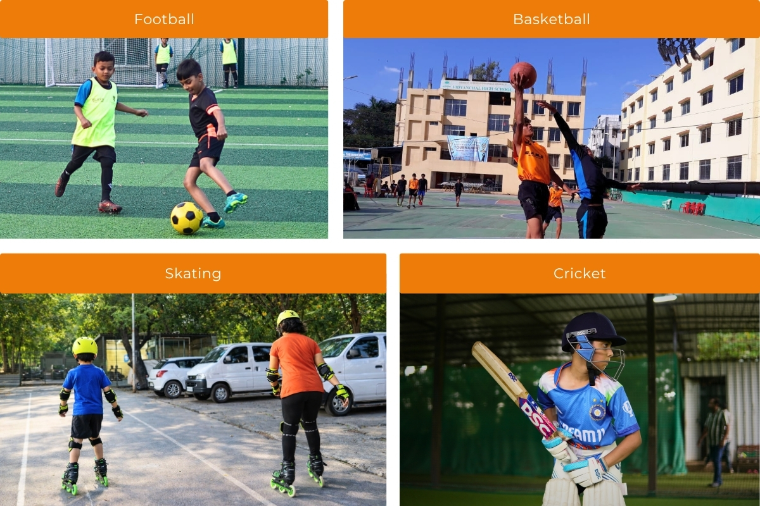
At Vidyanchal Sports Academy, this philosophy is central to how young athletes are introduced to sports. Instead of pushing early specialization, the academy encourages children to experience different disciplines such as football, cricket, basketball, skating, and traditional sports. This approach allows young athletes to develop a broad base of athletic ability while discovering the activities they enjoy most.
Understanding why multi-sport training works requires looking at the science of child development, movement learning, and sports psychology.
What Is Multi-Sport Training?
Multi-sport training refers to participating in more than one sport during childhood and adolescence, particularly between the ages of 5 and 14. Rather than focusing on a single discipline, children rotate across different sports that develop complementary physical and cognitive skills.
For example, a child might train in:
- Football for endurance and agility
- Basketball for coordination and reflexes
- Cricket for timing and strategic thinking
- Skating for balance and core strength
This diversity strengthens the body in a more balanced way than repetitive training in a single sport.
At Vidyanchal Sports Academy, children are encouraged to explore multiple sports before deciding which one they may want to pursue more seriously as they grow older.
The Science Behind Multi-Sport Development
Sports science organizations around the world support multi-sport exposure during childhood. One widely referenced model is the Long-Term Athlete Development (LTAD) framework, which recommends that children build physical literacy before specializing.
Physical literacy includes:
- Balance
- Coordination
- Agility
- Strength
- Spatial awareness
When children experience different sports, they develop these foundational abilities more effectively.
Research published by the American Academy of Pediatrics has also shown that early specialization in a single sport increases the risk of overuse injuries, burnout, and long-term dropout from athletics. By contrast, children involved in multiple sports demonstrate greater motivation and sustained participation.
This philosophy aligns strongly with the training approach followed at Vidyanchal Sports Academy, where young athletes gradually build movement skills through varied sports environments.
Motor Skill Development Through Diverse Movement
One of the biggest benefits of multi-sport training is improved motor skill development.
Different sports activate different movement patterns:
- Football develops running mechanics and foot coordination.
- Basketball strengthens reaction speed and lateral movement.
- Cricket improves hand-eye coordination and timing.
- Skating enhances balance and body control.
When these skills interact, children develop adaptable athletic intelligence. Their bodies learn to respond quickly to new movements and environments.
Sports psychologists describe this as transferable skill development — abilities gained in one sport enhancing performance in another.
At Vidyanchal Sports Academy, coaches regularly observe how children who participate in multiple sports often adapt faster and display stronger overall coordination.
Psychological Benefits of Multi-Sport Participation
Beyond physical development, multi-sport training has strong psychological benefits.
Reduced Burnout
Children who focus intensely on a single sport from a young age can experience burnout — a condition characterized by fatigue, frustration, and loss of interest.
Participating in multiple sports keeps training fresh and enjoyable. Each sport introduces new challenges and environments, preventing monotony.
At Vidyanchal Sports Academy, students often transition between sports sessions, which keeps enthusiasm high and encourages curiosity.
Greater Self-Confidence
When children succeed in different activities, they build broader self-confidence. Instead of tying their identity to one skill, they learn that improvement is possible in many areas.
Psychologists call this self-efficacy expansion — the belief that effort can lead to success across multiple contexts.
Multi-sport athletes often become more willing to try new skills, take risks, and overcome challenges.
Improved Cognitive Flexibility
Sports require quick decision-making and problem-solving. When children experience different sports, they encounter varied game situations and tactical challenges.
This improves cognitive flexibility, the ability to adapt thinking and respond to changing conditions.
For example:
- Football develops spatial awareness and passing decisions.
- Basketball strengthens fast reactions and court vision.
- Cricket encourages strategic thinking and patience.
Exposure to multiple game formats trains the brain to process information faster and more effectively.
At Vidyanchal Sports Academy, this cognitive growth is visible in how children communicate, anticipate plays, and respond to coaching instructions.
Injury Prevention Through Balanced Development
Another major advantage of multi-sport training is reduced injury risk.
Single-sport specialization often involves repeating the same movement patterns repeatedly. Over time, this can strain specific muscles and joints.
For example:
- Repetitive bowling in cricket can stress the shoulder.
- Constant sprinting in football may overload lower limb muscles.
When children train across multiple sports, different muscle groups are used in different ways, allowing the body to recover and strengthen more evenly.
This balanced development reduces the likelihood of overuse injuries and supports healthier long-term athletic participation.
At Vidyanchal Sports Academy, coaches monitor workload carefully and encourage varied training activities to maintain physical balance.
Social Development and Team Interaction
Multi-sport training also exposes children to different team environments and coaching styles.
This experience helps them:
- Build communication skills
- Adapt to new teammates
- Understand diverse strategies
- Develop leadership qualities
Children who play multiple sports often become more socially adaptable. They learn to collaborate with different groups and respect varied playing styles.
The community environment at Vidyanchal Sports Academy encourages these interactions by bringing together students from multiple sports programs within the same campus.
When Should Children Specialize?
While multi-sport training is recommended during early development, some athletes may eventually choose to specialize in a particular sport.
Sports science research suggests that specialization typically becomes appropriate around ages 14–16, depending on the sport and the athlete’s goals.
By that age, children who have participated in multiple sports often possess:
- Stronger athletic foundations
- Better injury resistance
- Higher motivation
- Greater tactical awareness
Many elite athletes worldwide have followed this pathway, beginning with multi-sport participation before focusing on their primary discipline.
At Vidyanchal Sports Academy, the goal is not to rush specialization but to help young athletes discover where their passion and strengths naturally lead.
The Role of Parents in Multi-Sport Development
Parents play a key role in supporting multi-sport participation.
Encouragement should focus on:
- Exploration rather than early achievement
- Enjoyment rather than pressure
- Effort rather than comparison
Allowing children to try different sports builds confidence and helps them develop a deeper connection with physical activity.
At Vidyanchal Sports Academy, parents are encouraged to view sports as part of holistic development — not just competition.
Why Multi-Sport Training Matters More Than Ever
Modern lifestyles often limit natural physical activity for children. Screen time, academic pressure, and urban living have reduced opportunities for unstructured play.
Structured multi-sport training helps fill this gap by providing a safe environment where children can move, learn, and grow.
Programs at Vidyanchal Sports Academy aim to recreate the diversity of movement children once experienced naturally — running, jumping, balancing, and competing across different sports.
Conclusion
Multi-sport training offers one of the most effective pathways for developing young athletes. By exposing children to different sports, it builds stronger bodies, adaptable minds, and confident personalities.
The research is clear: children who participate in multiple sports during their early years tend to stay active longer, experience fewer injuries, and develop broader athletic abilities.
At Vidyanchal Sports Academy, this philosophy shapes every training program. Through a diverse sporting environment and supportive coaching, young athletes are given the freedom to explore, grow, and discover their strengths.
Because the goal is not simply to create players — it is to nurture well-rounded individuals who carry the lessons of sport into every aspect of life.